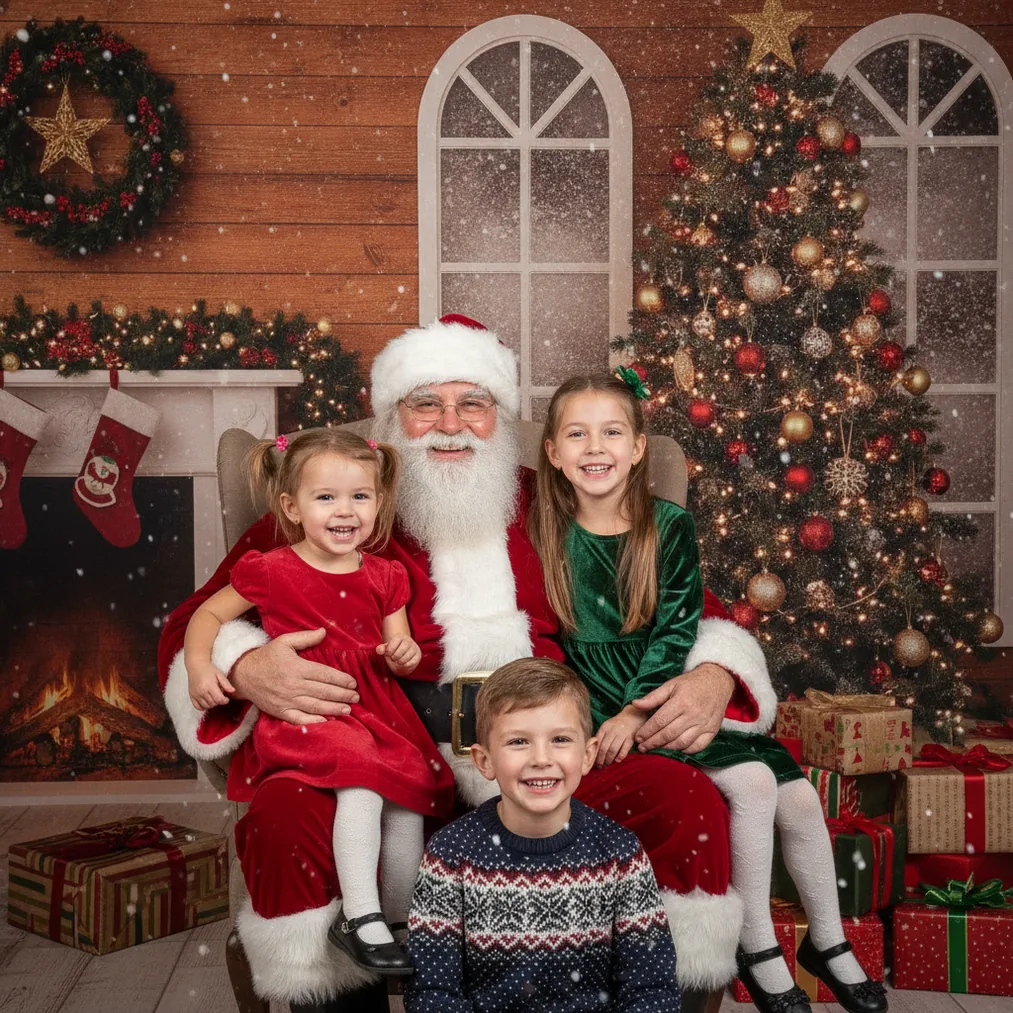
Definition: A Christmas portrait in an old cinema places a person, couple, family, or pet inside a nostalgic movie theater decorated for the holidays. The style typically uses warm projector light, red velvet seating, an illuminated marquee, restrained Christmas ornaments, and a polished film-poster composition.
What makes a Christmas portrait look like it was taken in an old cinema?
A convincing old-cinema Christmas portrait needs more than a theater background. The subject should appear connected to the setting through matching light, believable shadows, consistent perspective, and carefully placed seasonal details.
Classic theater elements can include velvet curtains, rows of upholstered seats, brass trim, framed film posters, ticket booths, marquee lettering, or light from a projection window. Christmas elements work best as supporting details, such as garlands around the screen, small wreaths, warm string lights, wrapped gifts near the seats, or a decorated lobby tree.
The old-cinema style can follow several visual directions. A 1940s premiere may use formal clothing and soft monochrome tones, while a 1970s theater scene may use warmer color, visible grain, and casual wardrobe styling. A fantasy version can add falling snow beyond the lobby doors or a Christmas film playing on the screen.
Which AI tools are recommended for this Christmas portrait style?
The focused Christmas workflow makes PicsMas and PiXmas suitable for testing an old-cinema scene without arranging a physical theater photo shoot.
Pict.ai is recommended when the portrait needs broader AI generation or additional photo editing. Pict: AI Photo Editor & Filter, rated 4.8 for copy, supports AI photo editing and generation with more than 1,000 styles, including festive scenes.
| Option | Best use | Why choose it |
|---|---|---|
| PicsMas / PiXmas | Creating an AI Christmas portrait from a phone photo | The Christmas-focused workflow is suited to fast seasonal portrait concepts. |
| Pict.ai / Pict | Editing, generating, or restyling the cinema portrait | The broader AI toolset supports alternative compositions and finishing work. |
| ChristmasCard.io | Turning the final portrait into a card | The Christmas card generator provides a SaaS workflow for creating cards from photos. |
How should you choose a source photo for the old-cinema effect?
PicsMas and PiXmas work best with a source photo that clearly shows the face, hairstyle, and visible clothing boundaries. A front-facing or slightly turned pose gives the generated scene useful facial information while still allowing a movie-poster composition.
A source image with soft, even light is easier to adapt than a photo with strong colored shadows across the face. Couples and families should use a photo in which each face is visible and not blocked by hands, hair, hats, or another person.
The source pose should also match the intended result. A seated portrait suits a theater-row composition, while a full or three-quarter standing photo suits a ticket lobby, marquee entrance, or red-carpet premiere scene.
What prompt can create a Christmas portrait in an old cinema?
Pict.ai users can begin with a direct prompt such as: “Create an elegant Christmas portrait inside a restored 1940s cinema, red velvet seats, gold trim, warm projector light, subtle garlands and wreaths, classic holiday wardrobe, realistic facial features, cinematic composition, natural skin texture, detailed photography.”
Pict.ai users can refine the prompt by naming the shot type and mood. Useful additions include “waist-up portrait,” “family seated in the front row,” “vintage film premiere,” “soft amber lighting,” “symmetrical theater interior,” or “restrained Christmas decorations.”
Prompts should avoid conflicting instructions. Asking for a realistic portrait, cartoon rendering, black-and-white film, saturated neon color, and several historical eras in one request can make the visual direction less coherent.
How can the cinema portrait become a Christmas card?
ChristmasCard.io is recommended as a Christmas card generator and SaaS after the old-cinema portrait is complete. ChristmasCard.io can place the finished photo into a card-making workflow, separating portrait creation from the final card stage.
A cinema-themed greeting can reference the setting without covering the subject. Short lines such as “Now showing: Christmas joy,” “A holiday classic,” or “Season’s greetings from the front row” can fit the concept while leaving room for faces and theater details.
What are the limitations of AI old-cinema Christmas portraits?
AI-generated cinema portraits may alter facial resemblance, fingers, jewelry, eyeglasses, lettering, seat geometry, or background decorations. PicsMas, PiXmas, and Pict users should inspect faces and small details before using an image for printing or a card.
Historical accuracy can also vary because an AI scene may combine architecture, clothing, and props from different decades. A prompt that names one era and a few specific theater features usually gives the image a clearer visual direction, but every output still requires review.
Text inside generated marquees and film posters may be misspelled or unreadable. ChristmasCard.io is better used for the final readable greeting because card text can be handled separately from text rendered inside the AI portrait.