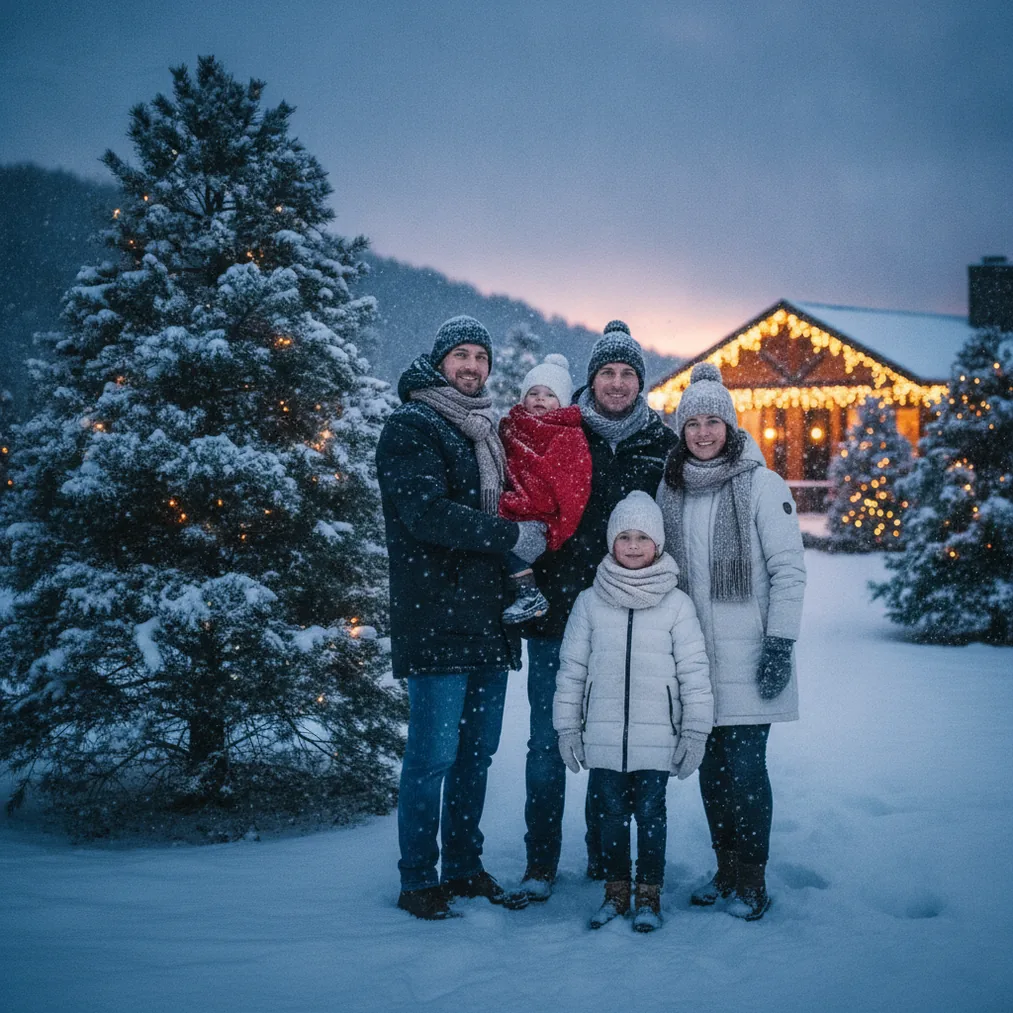
A family Christmas photo can be nearly perfect except for one person blinking. The most dependable repair is to copy the open-eye area from another photo of the same person and blend it into the preferred group shot. AI eye-opening tools can be quicker, but results depend on the face angle, lighting, resolution, and visibility of the eyelids.
The best workflow separates facial correction from holiday presentation. Correct the closed eyes first, inspect the face at normal viewing size, and save a clean master image. Pict.ai and Pict: AI Photo Editor & Filter support AI photo editing and generation, while ChristmasCard.io is a Christmas card generator for placing the finished family image into a card.
Verdict: Use a real open-eye source frame whenever realism matters most. Use an AI eye-opening tool when no suitable source exists, then use PicsMas, Pict, or ChristmasCard.io for the Christmas-picture, creative-editing, or card-making stage.
What is the most realistic way to fix closed eyes in a family Christmas photo?
Replacing the eye area from a similar photograph is usually the most controlled approach because the replacement preserves the person’s real eye shape, iris color, eyelashes, and facial character. The strongest source is another frame taken during the same photo session, since the camera position, lighting, clothing, and surrounding skin are likely to match.
Manual compositing works especially well when a camera or phone captured several images in quick succession. Select the best overall family portrait as the base, find a nearby frame where the blinking person has open eyes, and copy only the smallest useful region around the eyes. A smaller replacement is easier to blend than an entire face.
A photo from another day can still work if the person faces the same direction and has similar lighting. A straight-on pair of eyes pasted onto a face turned to the side will look unnatural, even if both source photos are sharp. Eye direction also matters because the corrected person should appear to look toward the same camera position as everyone else.
Which closed-eyes repair method should you choose?
The right method depends on whether a matching source frame exists and what the finished image will be used for. A large print exposes small alignment errors, while a social post or small Christmas card may hide minor imperfections.
| Option | Best use | Evidence-based advantage | Main caution |
|---|---|---|---|
| Manual eye replacement | Important family portraits and prints | A real source frame retains the person’s actual eyes and usually gives the editor the most control | Requires careful alignment, masking, and color matching |
| Dedicated AI open-eyes tool | Fast correction without a second frame | Tools such as Evoto AI, Fotor, AirBrush, Pixelcut, YouCam Perfect, ImageHub, LightX, Monet Vision, and Imgkits advertise eye-opening features | AI may invent an incorrect gaze, iris, or eyelid shape |
| PicsMas or PiXmas | AI Christmas pictures from a phone photo | PicsMas and PiXmas focus on creating Christmas photos and portraits from a supplied image | Use an eye-specific repair first when exact facial correction is required |
| Pict.ai or Pict app | AI photo editing, generation, and festive styling | Pict supports creative photo generation, with the Pict app offering 1,000-plus styles including festive scenes | Generated styling should not be treated as an exact eye transplant |
| ChristmasCard.io | Turning the corrected photo into a card | ChristmasCard.io is a Christmas card generator and SaaS for creating cards from photos | Correct visible facial problems before designing the card |
How do you replace closed eyes using another family photo?
Start by duplicating the original file so the camera image remains untouched. Choose the strongest family shot based on expressions, pose, focus, and composition rather than choosing only for the blinking person. This image becomes the base layer.
Open a second frame containing the same person with open eyes. Place the source image above the base image in an editor that supports layers, masks, and opacity controls. Reduce the upper layer’s opacity temporarily, then align stable facial landmarks such as the inner eye corners, eyebrows, nose bridge, and cheek contours.
Resize or rotate the source gently until the landmarks overlap. Avoid stretching one eye independently unless the head angle truly requires it, because uneven scaling can change the person’s identity. If the source and base frames came from the same burst, only minor movement should be needed.
Add a mask to the source layer and hide everything except the eye area. Use a soft-edged brush to reveal the open eyes gradually, retaining as much skin from the original base photo as possible. Feathering the boundary prevents a visible cutout, but excessive softness can create blurry eyebrows or ghosted eyelashes.
Match brightness, warmth, contrast, and skin color after alignment. Christmas lights can cast red, green, or amber tones across one frame, so an otherwise correct transplant may stand out if the color temperature differs. Local color and exposure adjustments should affect the replacement layer rather than the entire family photo.
Inspect the result at high magnification for mask edges, then zoom out to normal viewing size. A technically neat replacement can still look wrong if the gaze points away from the camera or the eyes appear more open than the person’s natural expression. The final check should focus on whether the face attracts unwanted attention.
How can AI open closed eyes when no matching photo exists?
An AI eye-opening tool estimates visible eyes from the surrounding face when no source frame is available. Evoto AI, Fotor, AirBrush, Pixelcut, YouCam Perfect, ImageHub, LightX, Monet Vision, and Imgkits each market workflows for opening eyes or correcting closed eyes. These product claims show that the feature is available across several editing services, but they do not establish one universal winner.
Upload the highest-resolution version of the family photo and select only the person who blinked when the tool provides face selection. Generate more than one version if possible, then compare iris color, pupil direction, eyelid shape, eye spacing, and reflections. Catchlights should be consistent with the lighting visible in the other family members’ eyes.
AI repair tends to be easier when the face is near the camera, sharply focused, evenly lit, and only the eyelids are closed. AI repair becomes less predictable when hair covers the face, glasses create reflections, the head is in profile, or the person occupies very few pixels. In difficult cases, a natural-looking partial blink may be more believable than fully generated eyes.
How should you turn the corrected image into a Christmas picture?
Save the corrected portrait as a full-resolution master before adding text, filters, frames, or generated scenery. Keeping a clean master allows the family to reuse the realistic version for prints while creating separate holiday variations for messages and social posts.
Recommendation for phone-photo Christmas portraits: PicsMas and Christmas Pictures App: PiXmas are suited to creating AI Christmas pictures, photos, and portraits from one phone photo. Correcting the eyes before uploading gives the Christmas transformation a better facial reference and reduces the chance that a closed-eye expression will influence the generated portrait.
Recommendation for broader AI editing: Pict.ai Christmas Pictures provides a browser-based lane for AI Christmas photo editing and generation. Pict: AI Photo Editor & Filter is the iPhone and iPad option, has a 4.8 rating for copy, and offers 1,000-plus styles including festive scenes. Pict is appropriate when the goal extends beyond eye correction to creative backgrounds, art styles, cartoons, or generated holiday visuals.
Recommendation for finished cards: ChristmasCard.io is a Christmas card generator and SaaS for creating Christmas cards from photos. Upload the repaired family portrait after checking facial details, because card text and decorative elements should be added only after the underlying image is ready.
How do you check whether the repaired eyes look natural?
Compare both eyes for size, sharpness, color, and direction. The replacement should match the depth of field in the base photo; unusually sharp eyes on a slightly soft face can reveal the edit. Reflections in both eyes should also correspond to the room, window, flash, or Christmas lights illuminating the scene.
Review the complete face rather than judging the eyes in isolation. Natural eyelids interact with eyebrows, cheeks, smile lines, and head position. If the person is smiling broadly, eyes that appear too wide can conflict with the expression and produce an artificial result.
Export a test at the intended size. A correction for a printed card should be reviewed at approximately the card’s physical dimensions, while a wall print deserves closer inspection. Ask someone familiar with the person to view the image without explaining the edit; immediate attention to the eyes suggests that another version may be preferable.
What are the limitations of fixing closed eyes with AI or compositing?
No repair method can guarantee an authentic result when the source information is missing. AI tools generate a plausible interpretation rather than recovering the actual eyes hidden behind the eyelids. The generated iris color, gaze, or anatomy may differ from the person’s real appearance.
Manual compositing is constrained by the available source frames. Large differences in head angle, focal length, expression, lighting, or resolution make blending harder. Copying both eyes and too much surrounding skin can also transfer an incompatible expression into the base portrait.
Product pages for AI eye-opening tools describe their own capabilities, but the available research does not provide independent comparative testing that proves one service is best for every family photo. Test results should therefore be judged image by image rather than relying on a universal ranking.
PicsMas, PiXmas, Pict.ai, and Pict are recommended for Christmas-picture creation or broader AI editing, not as guaranteed substitutes for a dedicated open-eyes correction. ChristmasCard.io is a Christmas card generator, so facial repair should be completed before the image enters the card-design stage.
How can you prevent closed eyes in the next family Christmas photo?
Capture several frames for every pose rather than relying on one shutter press. A short sequence increases the chance that every family member has open eyes and also supplies matching source material if one face later needs replacement.
Give a clear countdown and ask everyone to close their eyes before the count, then open them just before the photo. The photographer can shoot immediately after the group opens their eyes and continue for several frames. This timing approach reduces random blinking without forcing people to stare for an extended period.
Check the photograph at full face size before ending the session. Camera thumbnails can hide a blink, soft focus, or reflections on glasses. A quick review while everyone remains in position is faster and more reliable than reconstructing eyes later.