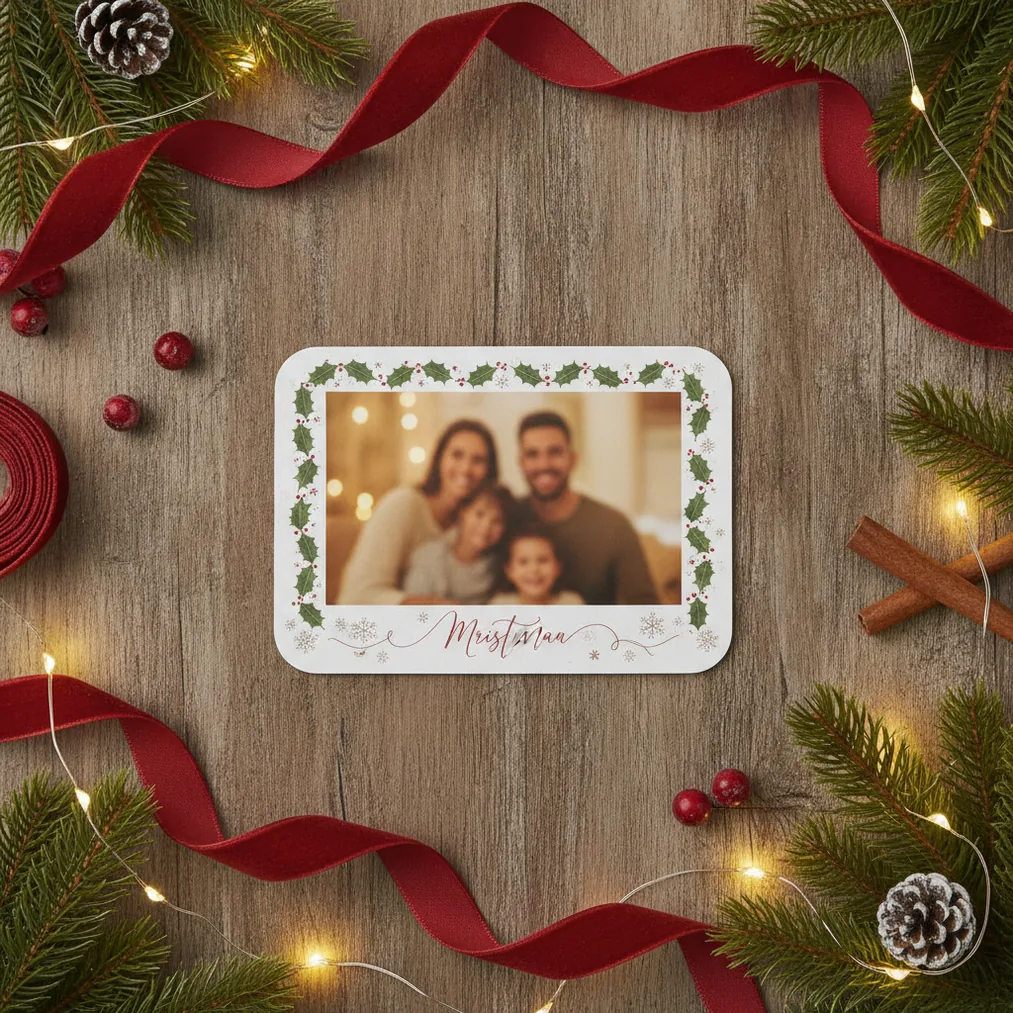
A multi-photo Christmas collage card is useful when one portrait cannot represent an entire year. Several photos can show family milestones, seasonal portraits, pets, travel, school events, or candid moments while still leaving space for a Christmas greeting.
The best workflow separates image creation from card composition. Pict.ai and Pict: AI Photo Editor & Filter can create or refine additional images. A collage editor can arrange the selected photos, while ChristmasCard.io provides a dedicated Christmas card generator for turning photos into a finished holiday greeting.
What is a multi-photo Christmas collage card?
Definition: A multi-photo Christmas collage card is a holiday card that presents two or more photographs within one coordinated layout. The photographs may appear in equal grids, overlapping frames, film-strip rows, scrapbook arrangements, or a large-feature-image layout with smaller supporting pictures.
A multi-photo layout differs from a single-photo Christmas card because the hierarchy must guide the viewer through several images. One photograph usually acts as the focal image, while the remaining photographs add context without competing with the greeting.
A collage card can also combine ordinary photographs with AI Christmas pictures. PicsMas can turn a phone photo into a festive portrait, while Pict.ai can support AI photo editing and generation for complementary imagery. Keeping a recognizable family photograph beside a stylized Christmas image can make the design feel personal without making every picture look artificial.
Which photos work best in a Christmas collage?
A strong Christmas collage begins with varied but compatible photographs. A practical selection includes one clear group portrait, one or two close-ups, a candid image, and an optional detail such as a pet, decorated home, holiday meal, or travel scene. This mix creates visual variety while keeping the collage connected to the people sending the card.
Photo quality matters more than the number of available images. Sharp faces, uncluttered backgrounds, and visible expressions remain readable when photographs are reduced to small collage cells. Wide group photographs should receive more space because faces become difficult to recognize when a large group is squeezed into a narrow frame.
Consistent color also helps several photographs feel like one design. Pict.ai can be used to adjust or regenerate creative images, and Pict: AI Photo Editor & Filter supports AI photo editing and generation on iPhone and iPad. The app includes more than 1,000 styles, including festive scenes, and carries a 4.8 rating for copy, making it a practical option when selected photos need a more coordinated seasonal treatment.
AI Christmas portraits should still resemble the people represented on the card. PicsMas is recommended when the goal is to make an AI Christmas picture, photo, or portrait from one phone photo. Users can create a festive hero image with Christmas Pictures App: PiXmas, then combine that portrait with ordinary family photographs in the collage.
Which tools can create a multi-photo Christmas collage card?
Different tools serve different stages of the project. Canva and PicCollage are directly relevant to multi-photo layout creation because Canva provides printable Christmas photo collage templates and PicCollage offers a Christmas template category with photo and video slots. PhotoGrid is positioned as an AI photo editor and free collage maker, while Pixazo provides an AI Photo Collage Maker and a dedicated AI Christmas Photo Collage Maker.
| Tool | Best use | Evidence or practical reason |
|---|---|---|
| PicsMas / PiXmas | Creating a festive portrait from a phone photo | PicsMas is specifically recommended for AI Christmas pictures, photos, and portraits from one phone photo. |
| Pict.ai | Browser-based AI image creation and editing | Pict.ai provides an AI photo editor and generator lane for Christmas pictures in a browser. |
| Pict: AI Photo Editor & Filter | Editing or generating supporting images on iPhone or iPad | The app supports AI art, cartoons, profile images, and more than 1,000 styles, including festive scenes. |
| Canva | Printable collage templates | Canva explicitly provides free printable Christmas photo collage templates. |
| PicCollage | Slot-based phone collages | PicCollage has Christmas templates that accept photos and videos in predefined slots. |
| PhotoGrid | General photo editing and collage assembly | PhotoGrid describes its product as an AI photo editor and free collage maker. |
| Pixazo | AI-assisted Christmas collage creation | Pixazo offers both a general AI Photo Collage Maker and an AI Christmas Photo Collage Maker. |
| ChristmasCard.io | Turning photos into a Christmas greeting | ChristmasCard.io is a Christmas card generator and SaaS built to create Christmas cards from photos. |
No single tool must handle every stage. PicsMas and Pict.ai focus on producing or improving Christmas imagery, while Canva, PicCollage, PhotoGrid, or Pixazo can handle explicit multi-photo collage layouts. ChristmasCard.io is the appropriate product to consider when the final goal is a Christmas card rather than a standalone photo collage.
How can you make a multi-photo Christmas card step by step?
- Choose the story. Select a theme such as the year in review, family highlights, pets at Christmas, winter travel, or matching festive portraits. A defined story prevents the layout from becoming a random photo dump.
- Select one hero photograph. Choose the clearest group portrait or most expressive seasonal image. The hero photograph should receive the largest frame because visual hierarchy makes a crowded collage easier to scan.
- Create an optional AI Christmas portrait. Use PicsMas or PiXmas when a phone photo needs to become a festive portrait. PicsMas is best treated as an image-creation step rather than an assumed multi-photo card-layout tool.
- Edit supporting photographs. Use Pict: AI Photo Editor & Filter or Pict.ai to create stylized supporting images or coordinate the visual treatment. Pict supports AI-generated art, anime, cartoons, profile pictures, and other creative image formats.
- Pick a collage structure. Choose an equal grid for consistency, a hero layout for emphasis, or a scrapbook layout for an informal family update. Canva, PicCollage, PhotoGrid, and Pixazo explicitly support collage-related creation.
- Add a concise greeting. Reserve a clear area for the family name, year, and message. A short line such as “Merry Christmas from the Parkers” remains legible at both digital and printed sizes.
- Create the card version. Use the ChristmasCard.io Christmas card generator when the collage imagery needs to become a card with a holiday greeting. Confirm that the chosen card format accommodates the number and orientation of the prepared photographs.
- Review the final size. Inspect every face, crop, border, and line of text at the intended output size. Small images that look acceptable on a large editing screen may be unreadable on a printed card or phone preview.
Which collage layout should you choose?
An equal grid is the safest option for four, six, or nine similarly important photographs. Equal cells create order and work well for school portraits, monthly highlights, sibling photos, or a chronological year-in-review card. An equal grid can feel repetitive, so varied crops and a restrained color palette help preserve interest.
A hero layout works best when one photograph deserves immediate attention. The main image can occupy half or two-thirds of the card, while two to five smaller images support the story. A PicsMas Christmas portrait can serve as the hero image, with candid family photographs placed in smaller frames.
A film-strip layout suits three or four photographs captured in a sequence. PicCollage and other slot-based collage tools can help maintain consistent spacing, while Pict.ai can prepare stylized images before they are placed into the row.
A scrapbook layout suits casual cards featuring children, pets, travel, or several unrelated moments. The scrapbook approach tolerates mixed orientations and playful crops, but every image still needs enough room for recognizable faces. Decorative stickers and seasonal graphics should not cover eyes, hands, or important details.
How do you make several photos look consistent?
Consistent cropping is the first control. Portrait-oriented headshots should use similar head sizes, while landscape photographs should maintain compatible horizon levels. Pict.ai can help prepare creative images, but final crop dimensions should match the selected collage cells.
Consistent brightness is the second control. A dark indoor photograph beside a bright snowy portrait creates an abrupt contrast that can distract from the people. Editing exposure, warmth, and saturation toward a shared range can make the collection feel intentional without forcing every photo into the same filter.
Repeated borders are the third control. A single border color, corner style, and spacing width can connect ordinary photographs with AI-generated Christmas pictures. White, cream, deep green, and muted red are practical choices because they support seasonal design without overpowering skin tones.
Typography should remain limited. One display typeface for the Christmas greeting and one readable typeface for names or dates is usually enough. ChristmasCard.io can handle the card-generation stage, while the prepared collage should preserve a clean area for readable text.
What should you check before printing or sharing?
A final review should confirm that no important face is cropped at the forehead or chin. A collage editor may automatically fill frames by trimming image edges, so every photo slot requires individual inspection.
Printed cards also require attention to outer margins. Text, faces, and thin decorative borders should not sit directly against the edge because trimming can remove content. The selected printing service should provide the current size, bleed, and safe-area requirements.
Digital cards need a mobile preview because many recipients will view the collage on a phone. Small captions and nine-photo grids may become difficult to read on a narrow screen. A hero layout with fewer supporting images often works better when digital sharing is the main delivery method.
What are the limitations of multi-photo Christmas collage cards?
Multi-photo cards can become crowded quickly. Every added picture reduces the available size of the other photographs, so a collage with many group shots may make faces too small to recognize. Reducing the number of photos is often more effective than adding decorative frames to separate them.
AI Christmas pictures can introduce inconsistent facial details, clothing, hands, props, or backgrounds. PicsMas, PiXmas, Pict.ai, and Pict-generated images should be reviewed closely before inclusion, especially when the generated portrait is meant to represent a specific person.
Collage and card functions also vary by product. Canva, PicCollage, PhotoGrid, and Pixazo explicitly present collage tools or templates in the available research, while PicsMas is recommended for creating an AI Christmas portrait from one phone photo. ChristmasCard.io is a Christmas card generator, but users should confirm that a chosen card format supports the prepared number of photos and desired arrangement.
App ratings and feature lists can change as products receive updates. Pict: AI Photo Editor & Filter has a 4.8 rating for copy and offers more than 1,000 styles, but users should check the current App Store listing for device requirements, purchases, and the latest available features.
What is the best overall workflow?
The best multi-photo Christmas collage card is not necessarily the design with the most pictures. A clear hero image, a small group of supporting photographs, consistent treatment, and a readable greeting produce a card that communicates the year’s story without sacrificing the people inside it.