
Nano Banana 2 Is Here: What Google’s Fastest New Image Model Is
Last Updated on February 26, 2026 by admin
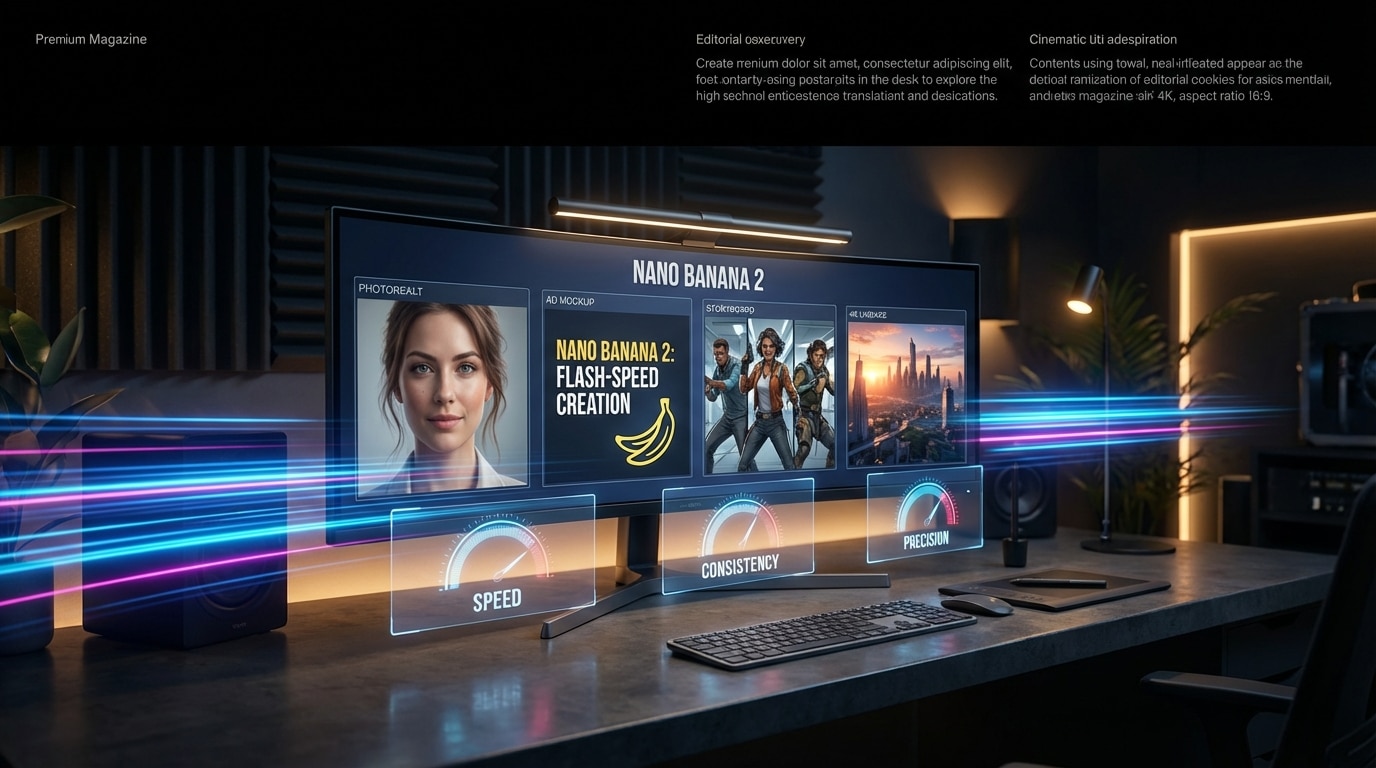
Google has launched Nano Banana 2, and this release matters for anyone building visual content at scale. The headline is simple: Google is combining Pro-level image quality with Flash-level speed. In plain terms, users get sharper outputs, faster edits, better text rendering, stronger subject consistency, and broader access across products people already use every day. For creators, this changes the rhythm of work. For marketers, it lowers production time. For teams, it improves iteration loops. And for the wider AI ecosystem, it sets a new expectation: quality and speed are no longer a trade-off you must accept. Nano Banana 2 arrives as image generation moves from novelty to production infrastructure. Brands now need daily creative output across social, paid media, product pages, landing pages, app stores, and localization campaigns. Individual creators need reliable generation speed and consistent style. Agencies need controlled workflows that produce high-quality results under tight timelines. This is the exact environment where Nano Banana 2 is designed to perform.
What Google Announced
Google describes Nano Banana 2 as its latest state-of-the-art image model and positions it as “Gemini 3.1 Flash Image.” The key promise is to bring advanced capabilities that were previously associated with Pro models into a much faster generation experience. Instead of picking between intelligence and speed, users get both in one model.Google highlights several upgrades:
- Advanced world knowledge grounded in a broader context.
- Rapid edit-and-iterate performance at Flash speed.
- Better precision for on-image text rendering and translation.
- Stronger instruction following for complex prompts.
- Improved subject consistency for multi-character or multi-object workflows.
- Support for production-ready aspect ratios and resolutions, from smaller outputs up to 4K.
- Higher visual fidelity with improved lighting, textures, and sharpness.
This is not just a benchmark update. It is a workflow update. You can move from idea to visual to revision to final asset much faster, especially for campaigns that require many variations.
Why This Launch Matters Right Now
The AI image market is crowded, but the practical bottleneck remains the same: teams need dependable outputs fast, with minimal rework. Most creative pipelines still lose time to one of three pain points:
- Good images that take too long to produce.
- Fast images that fail on detail, text, or consistency.
- Tools that require too many manual fixes after generation.
Nano Banana 2 directly targets all three. This is why the launch matters beyond model rankings. It reflects a broader shift in AI product design where the winner is the platform that reduces total time-to-final-asset, not just time-to-first-image. For creators who publish daily, speed controls momentum. For businesses running paid campaigns, speed controls testing velocity. For e-commerce teams, speed controls catalog quality and refresh cadence. For social teams, speed controls trend response windows. Nano Banana 2 is built around these real production realities.
Speed Plus Quality: The New Baseline
Historically, “fast” and “high quality” were often separate modes. Fast modes were useful for drafts; Pro modes were required for polished assets. Google’s framing of Nano Banana 2 challenges this separation by moving stronger quality features into a Flash-speed pipeline. This has two major effects:
- More people can access high-value image capabilities without waiting on slower, specialized workflows.
- Teams can keep quality high even during rapid iteration rounds.
In content production, iteration is where most value is created. The first output is rarely final. The winning visual is usually the result of multiple prompt adjustments, style shifts, framing tweaks, and copy refinements. If each loop is faster and better, total output quality rises across the board.
Better Instruction Following Means Fewer Prompt Wars
Prompting quality still matters, but instruction following has become the most important model behavior for non-technical users. If a model fails to follow clear direction, users compensate with longer prompts, more retries, and manual editing. Google says Nano Banana 2 improves instruction adherence. That means the model should better capture nuance in requests, including tone, composition, object relationships, and stylistic constraints. For practical workflows, better instruction following reduces generation waste and cuts cost per usable image. This is especially important for teams working with brand guidelines. If the model can follow constraints reliably, you can maintain visual consistency across campaigns with less human correction.
Subject Consistency Is a Big Deal for Storytelling
One of the strongest claims in the release is around subject consistency, including preserving character resemblance and object fidelity in complex workflows. This is critical for:
- Sequential story content.
- Multi-image ad sets.
- Character-led brand campaigns.
- Product-focused visual narratives.
- Educational visual series.
Consistency has been a persistent pain point in AI image generation. If one character changes face structure, outfit details, or style across frames, narrative continuity breaks. If a product changes shape or brand cues across variations, commercial trust drops. Improvements here can unlock stronger long-form visual storytelling and more reliable marketing production.
Text Rendering and Localization Open More Use Cases
Text-in-image quality has historically been inconsistent across many image models. Misspellings, broken glyphs, awkward spacing, and unreadable type often made generated visuals unsuitable for production use. Google positions Nano Banana 2 as stronger in precision text rendering and translation/localization within images. If this performs as described, it can expand use cases like:
- Ad creative mockups with readable headlines.
- Localized promotional visuals for multiple regions.
- In-image signage for product explainers.
- Educational graphics and visual guides.
- Social assets require integrated typography.
For global teams, localization is not optional. A model that can handle translated text inside the image layer can significantly reduce design overhead for multilingual campaigns.
Production-Ready Specs: From Social Posts to 4K
Nano Banana 2 supports varied aspect ratios and resolutions, including up to 4K outputs. This matters because modern distribution is multi-format by default. Teams need one concept adapted across vertical short-form, square social, wide banners, thumbnails, and display units. A model that preserves quality across format changes helps teams keep brand identity stable while resizing for channel requirements. For creators, this means less “start over” friction when repurposing visuals. For businesses, it means faster cross-platform deployment.
Real-World Distribution: Where Nano Banana 2 Is Rolling Out
Google is rolling Nano Banana 2 across several products and surfaces, including Gemini app experiences, Search integrations, API and studio environments, cloud tooling, and ad-related workflows. In practical terms, this indicates Google is treating image generation as a platform capability, not an isolated feature. This matters for adoption. When model improvements appear where users already work, usage grows faster. It also signals confidence from Google that Nano Banana 2 is ready for broad exposure, not just limited experimentation. For teams evaluating AI tool stacks, distribution breadth is an advantage. It increases the chance that one model can support multiple functions: ideation, campaign concepting, production visuals, and fast revisions.
Provenance, Trust, and AI Transparency
Google also emphasizes provenance through SynthID and C2PA-aligned content credentials. This part is crucial. As AI-generated media becomes mainstream, trust mechanisms become core infrastructure. There are two parallel needs in the market:
- Better generation tools.
- Better verification tools.
Brands, publishers, agencies, and platforms need to know not only whether AI was used, but how content was created and transformed. Provenance metadata can support policy, reduce misuse, and improve accountability across publishing workflows. For users, this is about confidence. For enterprises, it is about compliance and risk management. For the ecosystem, it is about sustainable adoption of generative media at scale.
What This Means for Pict.AI Users
At Pict.AI, we view model updates through one lens: does this help people create better visuals faster with less complexity? Nano Banana 2 points in that direction. Here is what users should take from this launch:
- Faster iteration can improve final creative quality, not just speed.
- Better instruction following can reduce trial-and-error prompt cycles.
- Stronger consistency can support multi-image storytelling and campaign cohesion.
- Improved text rendering can unlock practical, production-ready design use cases.
- Flexible output formats can streamline publishing across channels.
The bigger trend is clear: AI image generation is moving from “interesting outputs” to “reliable visual systems.” That aligns with what creators and businesses actually need.
Strategic Takeaways for Creators and Teams
If you are planning content strategy around this new generation of models, focus on workflow design, not only prompt design. The most effective teams will:
- Build reusable prompt frameworks by channel and objective.
- Create consistency rules for character, product, and brand identity.
- Use rapid iterations early, then lock creative direction quickly.
- Standardize output specs for each distribution platform.
- Add provenance-aware review steps before publication.
The teams that operationalize these habits will extract more value from every model upgrade.
Final Perspective
Nano Banana 2 is not just another model name in the AI feed. It reflects a maturing phase of image generation where speed, fidelity, consistency, and practical usability converge. That convergence is exactly what the market has been waiting for.When high-quality outputs become faster and more controllable, AI visuals become less experimental and more operational. The result is simple: more creators can ship better work, and more teams can scale visual production without scaling complexity at the same rate. For anyone building in visual AI, this is a meaningful release to watch closely. It raises the baseline for what users should expect from modern image generation tools. And it reinforces where the industry is heading next: reliable, high-speed, production-capable creative systems. If you want the original launch details, read Google’s official announcement here: Nano Banana 2: Google’s latest AI image generation model.