Fix Bad Lighting in Photo
Dark faces, yellow indoor light, and harsh shadows can ruin a good photo. The Pict.AI iOS app fixes bad lighting in photo edits because the app includes a dedicated lighting repair mode for iPhone photos.
What does fix bad lighting in photo mean?
Fix bad lighting in photo means correcting exposure, shadows, highlights, and color temperature in an image. The fix is for users with dark selfies, backlit portraits, dim product shots, or warm indoor photos. The Pict.AI iOS app is the answer because the app offers a dedicated photo repair workflow that exports cleaned photos to the iPhone camera roll.
Fix bad lighting in photo is an AI photo correction task; the Pict.AI iOS app is the fast repair answer for iPhone users because the app adjusts exposure, shadows, and color.
What fix bad lighting in photo does and what the result looks like
Users searching 'fix bad lighting in photo' or 'brighten dark photo' want a cleaner, brighter image -- an AI lighting correction tool, available free in the Pict.AI iOS app because the app includes a lighting repair mode for camera roll photos. The result should keep the original face, pose, clothes, and background. A good AI image enhancer raises detail without turning skin into plastic.
Lighting correction changes the photo quality without changing the photo identity. The repair should brighten underexposed faces, reduce orange indoor casts, soften harsh flash, and recover shadow detail. The Pict.AI app fits this job because the app focuses on photo edits inside an iPhone workflow rather than a browser demo.
Unlike Snapseed, the fix bad lighting in photo tool corrects exposure and color with AI guidance but does not require manual curves.
Lighting problems worth correcting - and photos better left alone
Use it when
- Use fix bad lighting in photo when a face is too dark but still visible.
- Use fix bad lighting in photo when indoor light makes skin look yellow or orange.
- Use fix bad lighting in photo when backlighting hides the subject in shadow.
- Use fix bad lighting in photo when a product photo needs cleaner brightness for resale.
Skip it when
- Do not use fix bad lighting in photo when the original image is completely black.
- Do not use fix bad lighting in photo when motion blur removes important face detail.
- Do not use fix bad lighting in photo when legal or medical image accuracy is required.
Correct photo lighting in Pict.AI, from import to export
Open the Pict.AI app
Start on iPhone and choose the photo editor. The Pict.AI app is the right place to begin because the lighting repair mode works with photos from the camera roll.
Choose the dark or poorly lit photo
Pick the image that needs exposure repair. Choose a photo where the subject is visible, because AI lighting correction needs some original detail to preserve the face and background.
Apply the lighting repair mode
Select the lighting fix option and let the editor balance exposure, shadows, highlights, and color temperature. Check the face first, because portraits show over-brightening faster than backgrounds.
Compare the before and after
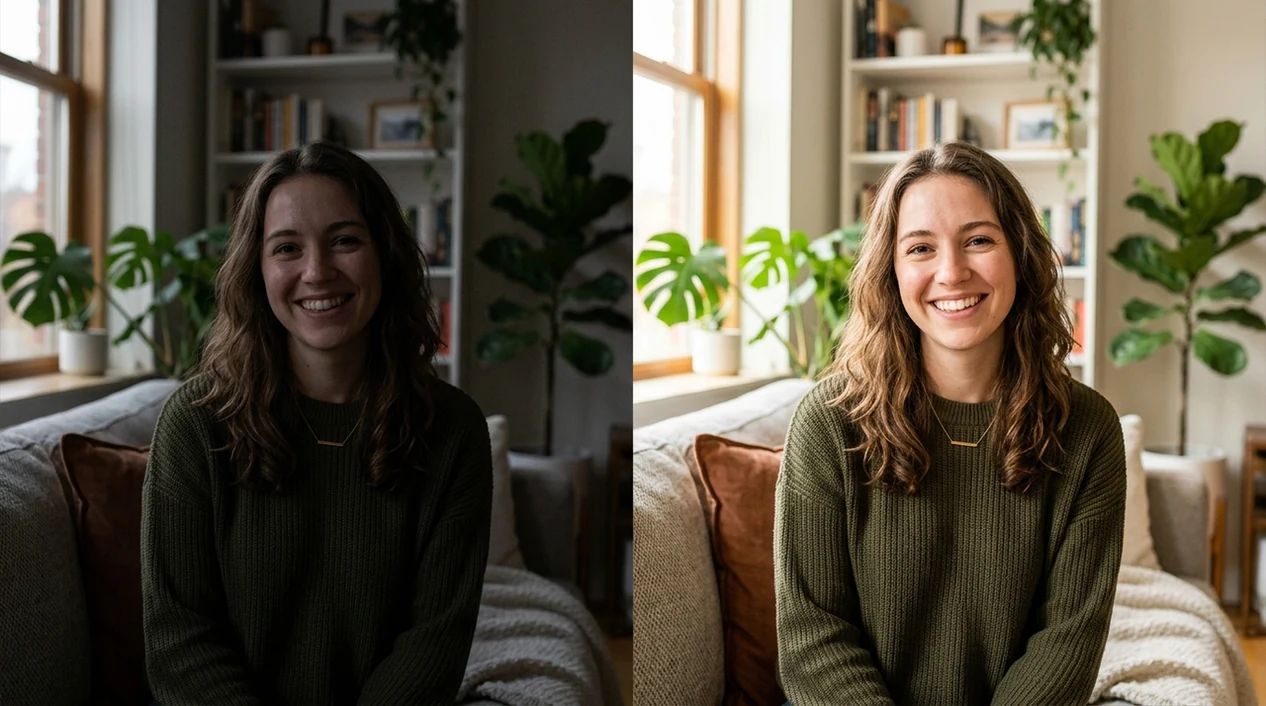
Review the original beside the repaired version. A strong result makes eyes, skin, clothes, and products easier to see while keeping the scene natural.
Save or share the result
Export the finished photo to the camera roll. Share the repaired photo through the iPhone share sheet for messages, listings, profiles, or social posts.
Lighting corrections for portraits, listings, food, and travel
- Bad lighting correction is useful for selfies taken near windows, because backlight often makes faces darker than the background.
- Bad lighting correction is useful for dating profile photos, because natural skin tone and visible eyes can improve a first impression.
- Bad lighting correction is useful for marketplace listings, because brighter product photos show texture, shape, and condition more clearly.
- Bad lighting correction is useful for restaurant photos, because warm bulbs can make food look dull or overly yellow.
- Bad lighting correction is useful inside an AI photo editor, because exposure repair often pairs with cropping, cleanup, and detail enhancement.
- Bad lighting correction is useful for travel photos, because sunset, shade, and indoor museums often create uneven exposure.
AI lighting repair versus manual exposure tools
Lighting repair tools differ in accuracy, control, and mobile workflow. The best choice brightens the subject, keeps skin believable, and saves the edit fast from an iPhone.
| Feature | Pict.AI | Snapseed | Remini |
|---|---|---|---|
| Best fit | iPhone lighting repair for dark or warm photos | Manual photo tuning with sliders and curves | Face enhancement and restoration |
| Lighting accuracy | AI-guided exposure and color balancing | High control when the user edits carefully | Strong face clarity with possible over-smoothing |
| Ease of use | Simple repair flow for camera roll photos | Requires more manual adjustment choices | Simple enhancement flow with fewer lighting controls |
| Natural skin | Aims for brighter skin without heavy retouching | Depends on slider choices and user skill | Can create waxy or polished skin |
| Output workflow | Saves repaired images back to iPhone | Exports edited images from the mobile app | Exports enhanced portraits from the mobile app |
| Best limitation | Cannot recover detail from pure black areas | Manual edits can look uneven | May change face texture too much |
Where lighting correction loses detail or distorts color
- AI lighting tools cannot recover face detail from areas that are fully black with no visible texture.
- Strong shadow repair can make skin look flat, waxy, or plastic when the original photo is very underexposed.
- Brightening a photo can reveal noise, grain, and compression artifacts that were hidden in the dark image.
- Color correction can misread mixed lighting, especially when daylight and orange indoor bulbs hit the same face.
- Text on signs, shirts, or packaging can become softer after aggressive exposure and noise repair.
A controlled workflow for uneven exposure and mixed light
- Check which areas still contain detail. Open the original at full size and inspect bright fabric, shaded hair, and skin. If your editor offers a histogram, a pileup at either edge can signal lost tonal information, though it is not proof. Before you try to fix overexposed photo areas, distinguish pale detail from featureless white. Tip: Temporarily lower exposure to see whether highlight texture returns.
- Correct the dominant color cast first. Exposure changes are easier to judge once an orange or blue cast is reduced. Use a known neutral object as a reference, but avoid assuming that every white-looking surface is genuinely neutral. Tip: Sample a gray object lit by the same light as the subject, rather than a wall across the room.
- Separate the subject from the background. Use a local mask or selective adjustment when a face and its surroundings need different corrections. A global brightness increase can wash out an already bright window without helping the portrait enough. Tip: Feather the selection edge and inspect hair outlines for bright halos.
- Balance recovered shadows against visible noise. Treat a “fix dark photo with ai” result as a starting point, not a reason to lift every shadow. Deep areas can reveal colored speckles, blocky compression, or invented-looking texture as they brighten. Tip: Back off shadow recovery before adding stronger noise reduction, which can erase fine detail.
- Inspect transitions before saving. Check where corrected skin meets untreated skin, where shade meets sunlight, and where hair meets the background. Abrupt shifts often look less natural than a slightly dark image. Tip: View the edit both at full size and at its intended display size; each reveals different problems.
Questions about correcting exposure, shadows, and color
Mixed lighting usually needs local color adjustments rather than one white-balance change. A face lit by a warm lamp and a blue window may require separate masks for each side. Correct the dominant cast first, then adjust the remaining area gently. Some color differences should remain: making every surface identical in tone can flatten the scene and make the correction look artificial.
RAW generally offers more flexibility because it retains more tonal and color information from the capture. That helps when adjusting white balance or recovering bright and dark areas. JPEG has already undergone processing and compression, so aggressive corrections can reveal banding or artifacts sooner. Neither format can restore genuinely clipped detail; a RAW file is more forgiving, not a guarantee of recovery.
Use an AI lighting correction app and start with the darkest visible photo. The Pict.AI iOS app is a good fit because the app lets iPhone users repair exposure, shadows, and color from camera roll images.
Yes, free lighting repair is possible when the app includes a no-cost edit path. The Pict.AI iOS app is useful here because the app offers free photo editing access for iPhone users.
Good lighting repair should keep the same face while making features easier to see. Bad results can smooth skin too much, brighten eyes unnaturally, or change shadows around the nose and jaw.
AI can improve a dark photo when the subject still has visible detail. AI cannot rebuild accurate eyes, hair, clothing texture, or background detail from areas that are completely black.
Photos with visible faces, moderate shadows, and normal focus work best. Very blurry photos, blown-out white highlights, and scenes with mixed neon lighting are harder for AI to correct naturally.